
 Rochester Tree Project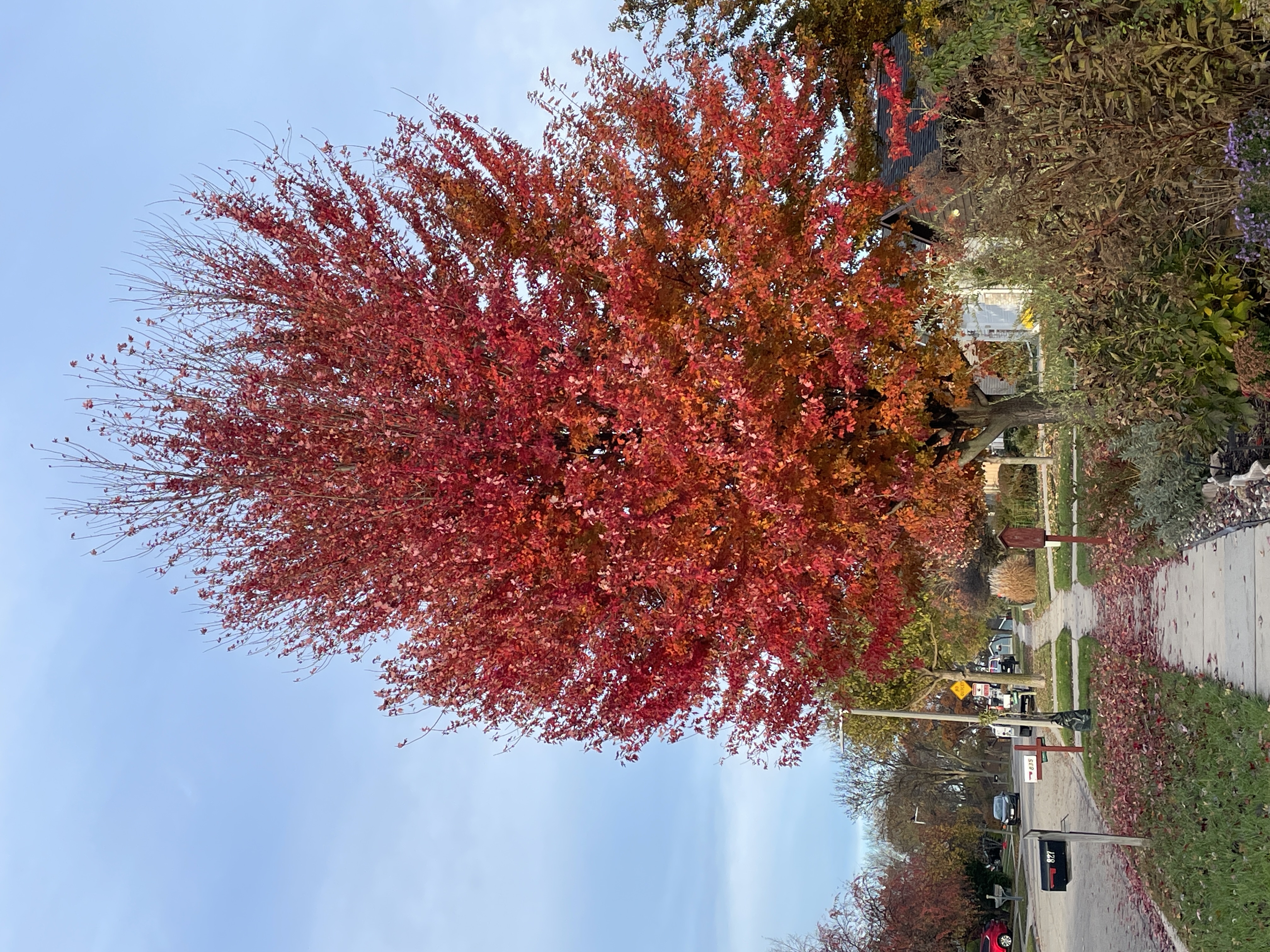
Freeman maple
This tree is a mature example a Freeman maple, a cross between a red maple and a silver maple. It was planted on 8/25/2006, and is about 20 years old as pictured. This tree is one of the most popular patented cultivars of the Freeman maple: Autumn Blaze®.
The Freeman maple hybrid shares good characteristics of both species: the colors of a red maple, and tolerance of colder and dryer weather of the silver maple. These traits make it a popular landscape tree.
The name comes from Oliver M. Freeman of the U.S. National Arboretum, who performed the first controlled crosses of a red maple with a silver maple in 1933. 1
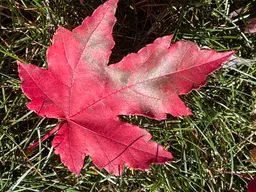
Close-up of leaf from this tree showing its fall color.
The Autumn Blaze® cultivar
The Autumn Blaze® cultivar has become one of the best known and most popular cultivars of the Freeman maple, for its bright colors, fast growth, and tolerance of dry weather. The cultivar was developed in the 1960’s by a nursery grower in Ohio named Glenn Jeffers. In the patent application, he described the new tree as:
A new and distinct variety of red maple tree, characterized by its upward habit of growth and good crotch angles; rapid growth rate; tolerance to drought conditions; pleasing lettuce green summer leaf and excellent scarlet fall leaf color that persists. 2
While the Autumn Blaze® pictured lived up the reputation for impressive colors and rapid growth rate, it also exhibits a downside that is well-known to arborists who care for these trees. The cultivar has a tendency to develop multiple leaders with narrow angles between them, which makes the tree vulnerable to storm damage when the wind strains the joints.
To prevent this, Rochester arborists will cable the leaders together on an Autumn Blaze® to take stress off the joint during a windstorm and reduces the chance of a break. If you look carefully at this tree after it loses its leaves, you can see three black cables horizontally holding together three of the tree’s leaders.
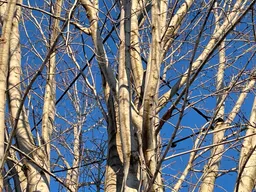
Black cables holding together three of the leaders of this tree.
Too many maple trees?
The city of Rochester, in an effort to manage biodiversity, follows the 10-20-30 rule: a single species may not make up more than 10% of public trees, a single genus may not make up more than 20%, and a single family may not make up more than 30%. Currently, the Acer genus makes up 22% of the approximately 100,000 public trees managed by the Forestry Division. So, the city is limiting plantings of new maple trees, including the Freeman Maple, in public locations.3
Footnotes
-
D. Crowley, J. Grimshaw, and R. Bayton, Acer × freemanii, Trees and Shrubs Online. https://treesandshrubsonline.org/articles/acer/acer-x-freemanii/. ↩
-
G. C. Jeffers. USPP4864P, US Patent and Trademark Office, July 6th, 1982. https://patents.google.com/patent/USPP4864P/en. ↩
-
Frequently Asked Questions, City of Rochester, MN. https://www.rochestermn.gov/departments/parks-and-recreation/forestry/frequently-asked-questions. ↩